Showing posts with label Dinner. Show all posts

Tuesday, 6 July 2010

Eating in Ireland


The Economist and I are in Ireland enjoying a little holiday on our way back to the US of A. Yes, we’re moving back permanently. We’re excited, but we’re also excited about Ireland.
Now, just because the Irish tiger is taking a cat nap does not mean the Irish food revolution is dead. It is alive and well, if the meals I have eaten here reflect the whole. This has largely been attributed to this woman:
I have written about Darina Allen before. She is very inspiring but can be intimidating. She runs a guesthouse and cooking school in County Cork and also... a restaurant! The Economist and I had our anniversary dinner there this year. It happened to fall on a Sunday, which is the one day a week that dinner is served as an all-you-can-eat buffet. However, this is not some greasy, rank Old Country Buffet-type affair—this was beautiful, delicious and very high class!
More on that later.
The night previous, we rolled into Cork City quite late and ended up eating dinner in the same restaurant where we once celebrated an anniversary (or was it a birthday?) when we lived in Ireland 6 years ago. The only thing I remember about that meal was the dessert—a gorgeous caramel and pear hot pudding served with vanilla ice cream—and the setting. It’s a gorgeous restaurant with tables arranged under cavernous brickworks. I’d describe it as classy but bustling. And it was certainly bustling with activity, even late at night when we got there. We decided to bring one of our Paris wines over with us to Ireland and drank it with our meal. The Economist had a cream of mushroom soup, which I swear is the same recipe from the Ballymaloe cookbook because I make a similar one. Whatever, it was delicious, at least the spoonfuls I ate. Everything was served with delicious Irish brown bread and butter. Then I had a pan seared scallop salad with a lemon beurre blanc. I am loving the hot salads. Especially when they come with fresh local seafood. The Economist had some kind of local cheese, hot, over salad with roasted pumpkin seeds and something else... can’t remember what! For dessert, we split a delicious meringue nest with lemon curd and passion fruit pulp. So good, I can’t tell you.
Well, then, the next night we had this absolute feast at Ballymaloe House. We arrived a bit early and were invited to a parlor where everyone was waiting for dinner, sipping pre-dinner drinks. Then we were shown into the dining rooms, and given our choice of soup. The Economist had the Moroccan lentil soup and I had a chicken consommé. The chicken consommé was absolutely delicious—crystal clear and so bursting with chicken flavor. And inside were delicate little shavings of fresh vegetables—among which were carrots and zucchini. It was so good I didn’t even ask for a taste of the Economist’s lentil soup.
Once we had eaten our soup and more of that same delicious brown bread (how do they make it???) we were INVITED into the buffet room. We could choose between starting with a starter course or going straight to the main course primarily of large joints of roasted meats. We could come back for each course as much as we wanted. I think I ended up getting four salad plates of starters alone. This was not the kind of buffet where they try to fill you up with cheap carbs to begin with. In fact, there were very few carbs at all and I had to ask politely to be given more of that brown bread. They started the buffet table with good stuff and ended with more good stuff. There were mussels and clams on the shell with some sort of delicious sauce. There was local fresh smoked salmon. There was Swedish gravalax with a dill mayonnaise. There were whole raw oysters. I tried one for the first time, and while it was pleasantly briny, the supposed aphrodisiac quality and the thought of the associated... shall we say... anatomy... left me less than desirous for a second. This one guy took, like, only 8 or something. There was also a shelled mussel, on a little round of brown bread with a mustard sauce and then topped with some kind of yellow mousse and decorated with a tiny little flower. There were also four different types of pate. Ooooh, I have such a weakness for pate. I had two slices of chicken liver pate with bread and it was very, very good. I’m only listing the things I ate, there was so very much more. Everything there, by the way, is house made with produce they grow and even some animals they rear themselves. Other items come from trusted farmers in the local area.
After the starters, you’re supposed to move on to a salad course, and there are so many salads to choose from. I ate, among others, some tomato salad. I was curious how this tomato salad would taste because in the Ballymaloe cookbook, Darina gives her recipe and insists that when making a tomato salad, tomato slices MUST be spread out in a SINGLE layer. And on the whole, I have to agree. It certainly made for a tasty salad. There were also just dressed greens, which are always good. There was a fantastic potato salad, probably the best I’ve ever eaten, which means I shall be looking at the recipe in the cookbook whenever I next want to make potato salad.
After I had eaten several plates of these things, I decided to transition to main dishes, those large joints of roast meats. There was such a choice and I pretty much had a slice of each. I had roast pork with applesauce, the most delicious rare roast beef, roast lamb off the leg, roast goose, and a delicious ham with hot, hot mustard. The only things I didn’t eat were the roast beef tongue and the turkey. I save my turkey eating for November and December.
Matt had a special vegetarian main dish, which was a lot like the one the night before—a cheese soufflé on salad leaves with walnuts and grapes. He said he liked it.
Then, after all that, there was still dessert. We could choose any or all of the following: coffee meringue roulade, strawberry shortbread tart, poached gooseberries, chocolate ice cream and crème brulee, all served with extra whipped cream. These items were ceremoniously wheeled on a trolley to each table as they decided they were finished with the main course. The chocolate ice cream was presented in another Ballymaloe House innovation, an ice bowl, a bowl made of solid ice on which scoops of ice cream are mounded to keep them from melting in the dining rooms. I had a slice of the strawberry shortbread tart, some crème brulee and some gooseberries, just to try them. The gooseberries were like grapes only they tasted more plain, rather like apples. The strawberry tart was delicious as well, but the real star of the dessert trolley was the crème brulee. It was presented family style, made up in a huge dish, about three quarters of an inch deep, glazed with a delicious carapace of caramelized sugar and piped with whipped cream all around the edges. Each serving came rather homily scooped up and put on the plate, the shell sliding a bit over the oozing cream. It tasted simply like a dream.
Finally, there was tea or coffee. By then we had been eating for almost three hours! The soup seemed a long, long time ago. It wasn’t gluttonous, manic, shovel-into-mouth eating, it was just a really genteel and civilized procession of courses, one following the other. Halfway through the tea though I simply had to give up, I could not eat one more bite nor drink one more sip.
It’s funny—it sounds like it was a really formal and rigid meal in a stuffy setting, but it was really so casually elegant. The servers were just guiding us through the whole process, we could eat as much as we wanted of everything, going up whenever we were ready, and if something was running short, they’d bring it over to your table for you. The tables were set with nice clean linens, simple glassware and—GASP!—real silver cutlery, which I LOVE. There is nothing quite like eating with real silver. It was a dream.
What an amazing meal! And who would have thought Ireland would be the location of some of the best food I’ve ever eaten?

Wednesday, 28 April 2010

Easy Vegetarian Spaghetti with Garlic Bread

This is a very satisfying meal for me, makes me think of home. And for some reason it is the one dinner with which I have to have a tall glass of cold skim milk. Normally I don't drink plain milk.
This is an easy vegetarian spaghetti sauce, so here are the easy ingredients. Adjust to your tastes

onion
bell peppers
zucchini (here in the UK they're called courgettes, don't ask me why)
garlic
tomato sauce
pasta of some sort--spaghetti here--it is, after all, a spaghetti sauce
dried chili pepper flakes
fresh basil

Start by chopping all the veg. Throw them in a pot with some olive oil. Start with the onions and zucchini to soften them first. Once they're half-way cooked, throw in some garlic along with the dried chili pepper flakes, salt and pepper.
Once they're about halfway cooked, throw in the peppers and cook for only a few minutes so that they keep crisp.
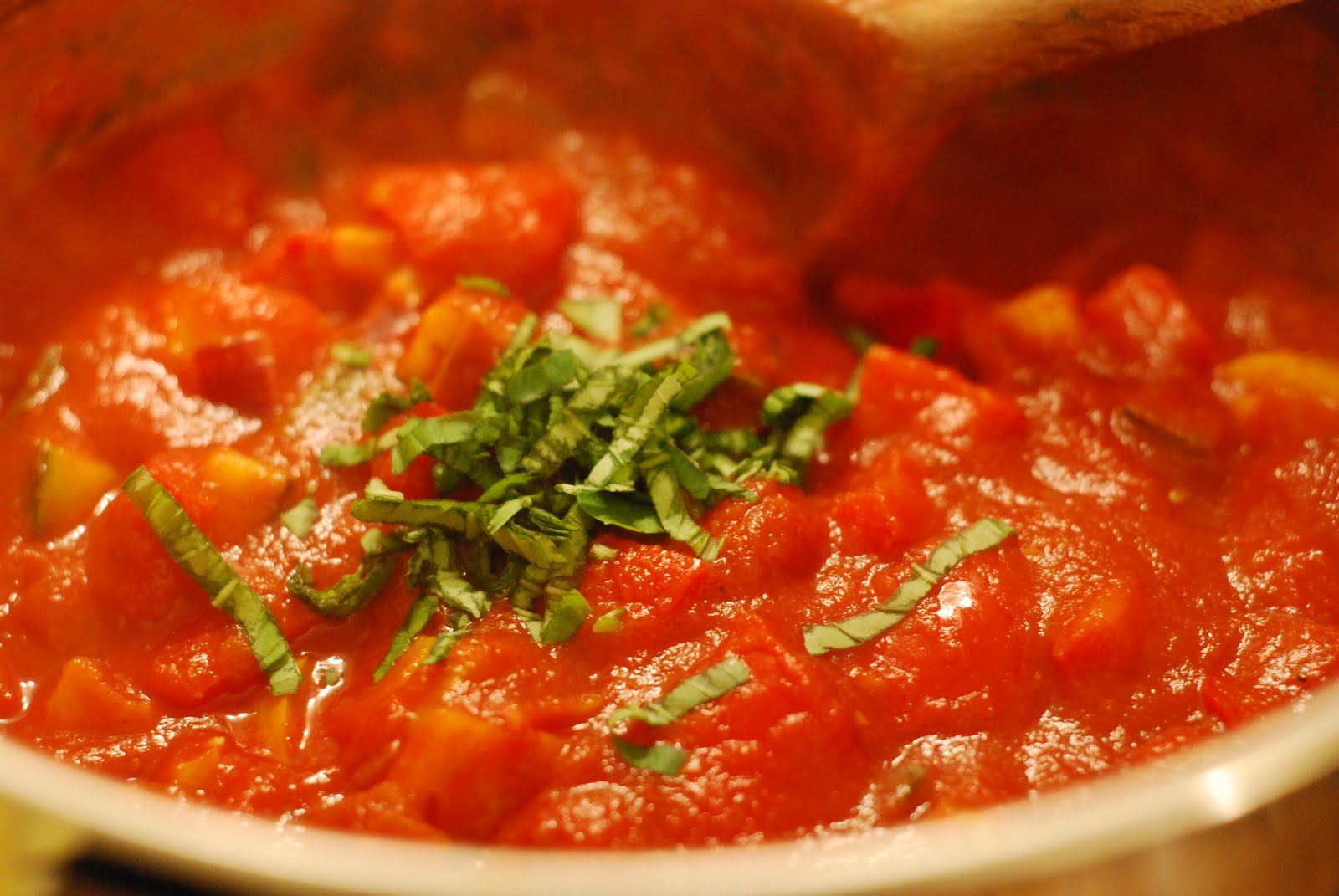
Pour in the tomato sauce and stir it up. Then cover with the lid slightly ajar and simmer until everything else is ready.
Get the water boiling and put the pasta on.
Now make the garlic bread using the above ingredients.

1 tbsp butter
1 tbsp roast garlic puree
salt
fresh basil or any other herb

Mix the butter and garlic up together.
Add the herbs and salt.
Mix it all up and prepare to smooth on to bread.
I'm using plain old sandwich bread.
I toast the bread on the first side under the broiler (called a grill here, in Her Majesty's realms). Spread the butter on the other side of the toast.
Put the garlic bread, butter side up under the broiler until it's not brown but sort of toasted. This is so as not to burn the garlic.
The sauce should be a bit thickened.
At this point I like to throw in a bit of fresh basil.
Plate it up! Some people like parmesan over the top. I don't. That's just me.

Friday, 9 April 2010

North African Cous Cous, Two Ways

In Paris The Economist and I had north African cous cous twice and they were our favorite meals. If you've never had it, it's basically a stew served over cous cous, a very tiny piece of wheat pasta. I'm making it two ways--a vegetarian version, and a lamb shank version. The idea here, especially with the meat, is to let it roast slowly in the oven for a long time on a low heat so the meat ends up tender, juicy and melting off the bone.
For the meat version, start with an oven-proof dish and enough lamb shanks to fill it loosely. I had never cooked lamb shanks before I made this stew for the first time, but I must say they are a very satisfying thing to cook and eat. You also need onions, a can of chopped tomatoes, some garlic and chicken (or lamb if you can it) stock.
There is a mix of spices that goes into the stew. Don't worry too much about quantities or the exact mix. Whatever you've got works, just make it spicy if you want. I used ginger, cumin, paprika, ground coriander, nutmeg, cinnamon, dried red chili pepper flakes and cayenne pepper.
The vegetarian cous cous the Economist had in Paris was called cous cous sept legumes--7 vegetables--but I couldn't think of a 7th, so my version is cous cous six legumes. For this version use whatever vegetables you have around. I like to use sweet potato, zucchini, onions, carrots (here little baby chantenay carrots--so pretty!), a can of chick peas and a can of chopped tomatoes. You also need more garlic and vegetable stock, as well as the spice blend from above.
For the cous cous you need cous cous, obviously, some boiling water, and I like to add raisins for a sweet burst.
So let's start the lamb stew. Put some olive oil in the bottom of a large saucepan. Once it's really hot, put the lamb shanks down into it to sear the outside of the meat. (I think I should have trimmed the fat off these lamb shanks, but I forgot to.)
This accomplishes the goals of giving the meat color (otherwise it will be hideously white and raw-looking), rendering down the fat and connective tissues on the outside and giving a bit more flavor by caramelising and crusting the outside. So I'm told.
When that's done, remove the shanks and set them in your oven dish to rest for a minute while you do the vegetables for the meat stew.
In the bottom of the saucepan, you'll get all the caramelized, concentrated meat juices and a bunch of rendered liquid fat. It's probably a good idea to skim the extra fat off, because you don't really need it. Leave a little bit there though, to cook the onions in.
Toss in the onion halves and minced garlic and give it a stir. This is not to cook the onions really, just to get them going so they roast/braise slowly in the oven later.
At this point, add the spices. A little bit of each one, but go easy on the nutmeg and if possible use a while cinnamon stick, not here, but later.
Next add the can of tomatoes.
And the chicken stock. Bring the whole thing to the boil.
Then pour the whole volume over the lamb shanks in the oven dish. Nestle a stick of cinnamon into the depths of the liquid to perfume the whole thing. Cover tightly with aluminum foil and put the whole into a very low oven, around 150 C (what is that in F? I don't know.)
Next, start working on the vegetarian version. Roughly chop all the veggies into largish chunks. In a hot frying pan, heat a little olive oil, then put in the vegetables, one at a time to sear the outside a bit. This is mostly for the color as before, and not an attempt to cook them. They'll just look so much prettier later.
Do each type of vegetable including the sweet potatoes, zucchini, onions and carrots. Pour them all into another oven dish. This time I used a sheet cake pan because I didn't have anything else.
Look at those pretty carrots!
In the same pan, reduce the heat, warm a little olive oil and add the garlic. Add a small amount, about 1/4 cup of the chopped tomatoes.
Throw in the spices.
And stir them into the tomatoes and garlic.
Next add the drained can of chick peas...
...the tomatoes and the vegetable stock. Stir and bring the whole thing to the boil.
Pour all the liquids over the vegetables in the oven dish.
Don't forget the cinnamon stick!

Cover tightly with aluminum foil and put it in the oven also.

Now it's pretty much a waiting game. You should leave everything in the oven for at least 2 hours. I left everything in for 4 or 5 hours. But the wait is soooo worth it.
Here is the lamb after 1 hour. Kind of sad looking, but you can tell it's getting tender.
Now after the full 4 hours, the meat is sliding off the bone, it's juicy and tender. Perfect.
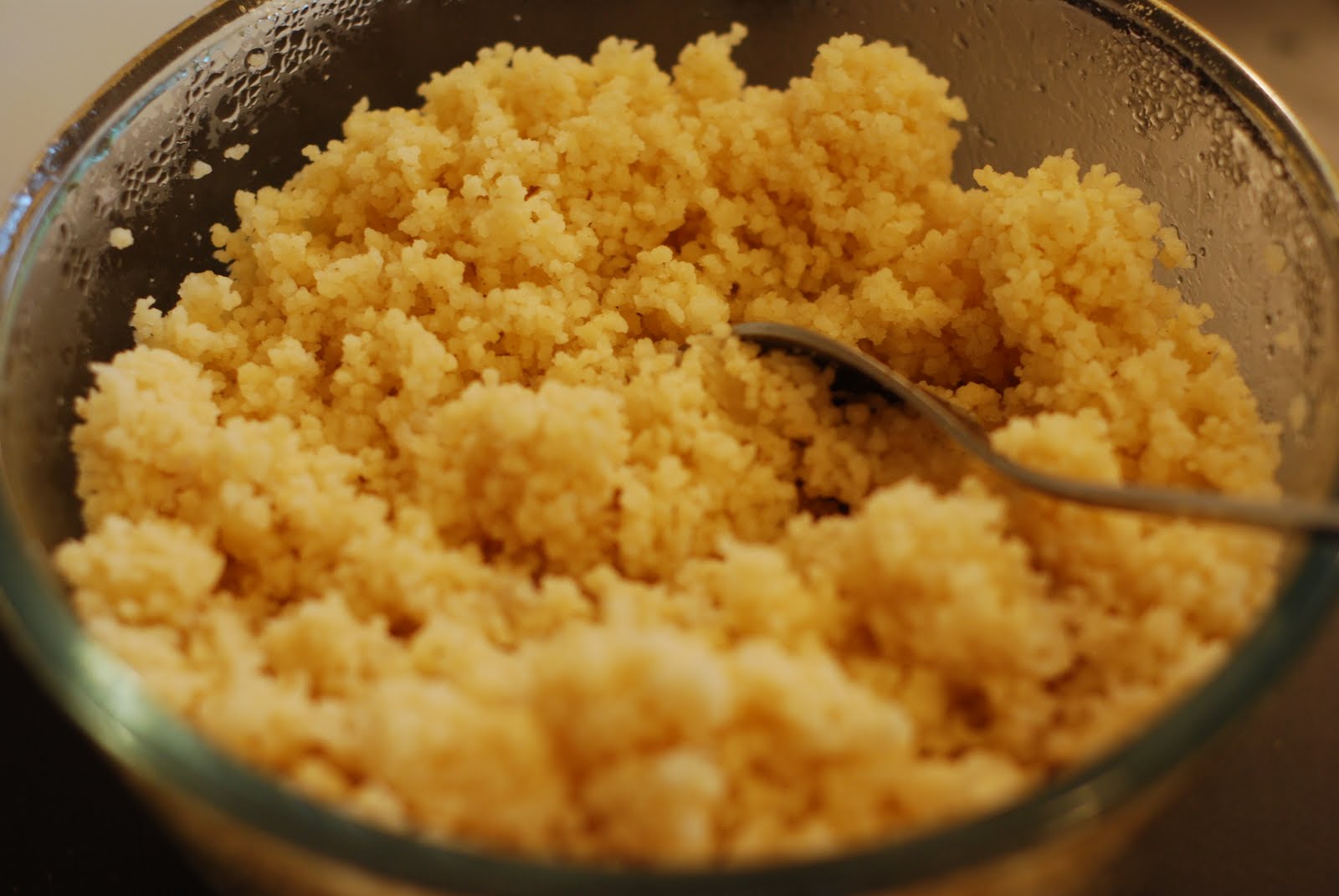
In the meantime, make the cous cous. I have the kind where to make it you just pour boiling water over and let it sit under plastic wrap for 5 minutes.
Then you sort of fluff it up with a fork.
I like to throw some raisins over the cous cous, then put some meat next to it, and pour over the oniony sauce.

It's so good!

And I don't have any pictures of the veggie version, because I forgot, but it looks pretty much the same. Use your imaginations.

Bon apetit!

Monday, 29 March 2010

Pepper and Halloumi Bake

This is one of my favourite quick recipes. It's adapted from Nigella Express and it's even better than Nigella's--sorry.

Basically it's a hot salad of sweet bell peppers and chopped halloumi with some spices and herbs, eaten picked up with pita bread, tortilla strips or some other bread. It's fast, adaptable between vegetarian and meat-containing, and leftovers warm up well. Once again, most importantly, it's delicious and very satisfying.
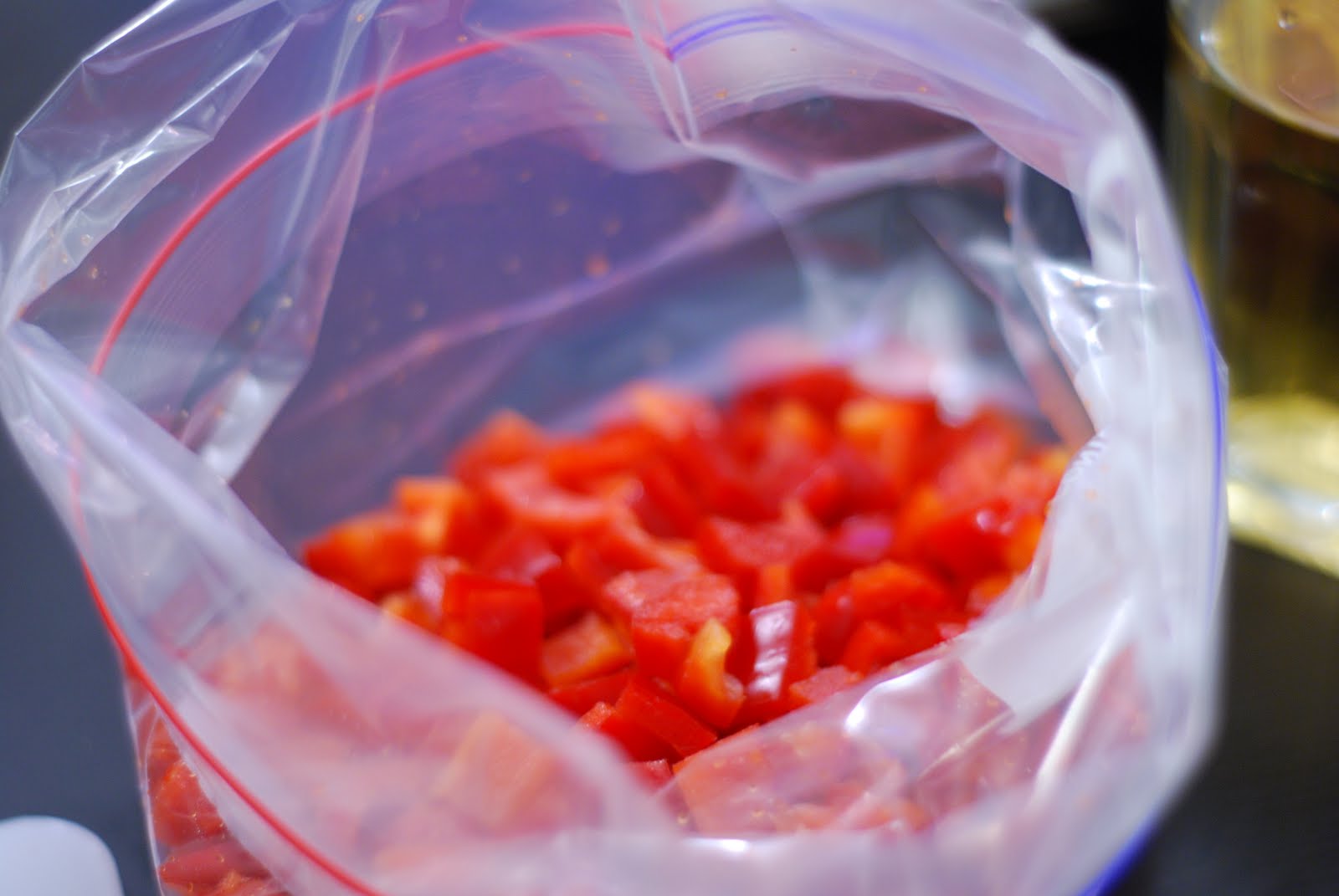
Start with bell peppers of course. Three large ones works in good proportion to a 250gm block of halloumi. The seasonings are garlic, salt and pepper, and some chili oil which I've made up, but a couple spoonfuls of olive oil and a couple of teaspoons of dried chili flakes also does the job. Adjust seasonings as you desire. Just remember that the halloumi is really salty and doesn't need too much more salt. Often I don't even bother with salt. I don't know why I put it in the picture. DON'T, however, skimp on the fresh ground black pepper. I love black pepper. I also love a fresh green hit with some fresh basil. My basil plant is thriving like you would not believe so I apply basil liberally, and at the very end. Step one: chop up those red peppers into a dice. You can chop them bigger, just make them convenient to scoop up onto a piece of bread.
Put them into a large zip lock bag. This just makes coating them with oil easier.
Chop up the halloumi into similarly sized chunks. Steal some halloumi to eat plain--it's a bit like cheese curds, squeeky and salty.
Throw that into the bag, along with a bit of fresh chopped garlic (here, my garlic puree--I told you, I put it in everything), the chili oil (or olive oil and dried chili pepper flakes), and tons of black pepper. A more course grind works well here. I like biting down on a sudden hot hit of pepper.
Shake that stuff up to coat in the oil and seasonings.
Tip it out onto a baking sheet. It goes in a 350F oven for 10 minutes. Told you this was fast.
Meanwhile I like to prepare the basil by making a chiffonade. Just lay all the basil leaves in a pile and roll the whole pile up really tight.
Look at my pink fingernails. They look pretty rad next to the green.
Then slice the leaves into a narrow chiffonade. Fluff the chiffonade to separate the little strings.
This time we ate the peppers and halloumi with a fresh baguette, sliced up and spread with some butter.
When it's baked, the peppers will be softened but still a bit crisp. The halloumi will take on a SLIGHTLY brown colour but hopefully will not be burnt because that doesn't taste good.
And finally sprinkle the basil on top. Scoop up a bit onto your bread, or scoop with the bread and pop that goodness into your mouth. It's really good.

Meat adaptation: sometimes when I feel I want the protein or when I have it around, I separate the baking into two sheet pans, and sprinkle some chopped up chorizo into one. It adds a whole other thing, being spicy and garlicky itself, but also delightfully meaty. Alternately, lay some pepperoni on your bread as you scoop up the peppers. Frankly, it's a rare recipe where it's actually equally good both ways.